EDUCATION IN MANY FORMS


Animal Ambassador Presentations

Field Trips

Multi-Session in-School Programs


Animal Ambassador Presentation

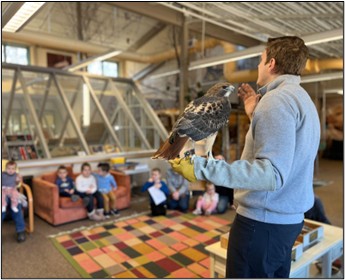
One of the most exciting ways for students of all ages to connect with nature is by coming face-to-face with the incredible animals that live in the forests, rivers, and fields around us.

An animal presentation from the New England Wildlife Centers (NEWCs) offers just that—an unforgettable experience where students can learn about the wild animals that share our world and how they are cared for when sick, orphaned, or injured in Massachusetts. During our presentation, we discuss:

  • The role of our wildlife hospital in rehabilitating injured and sick animals
  • Common challenges wildlife face when interacting with humans
  • Ways we can help protect and support local wildlife in our daily lives
  • Interesting facts about adaptations, anatomy and physiology of our Animal Ambassadors

What to Expect

Our engaging, interactive presentation includes a variety of live ambassador animals, such as:

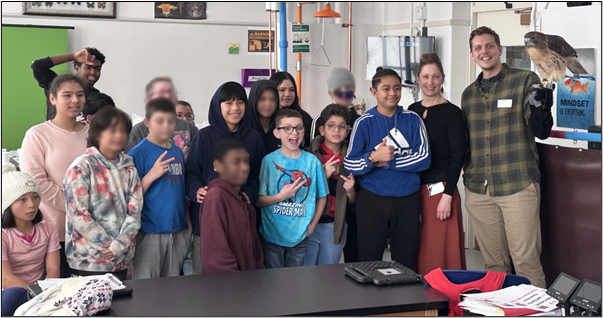
  • A Red-tailed Hawk
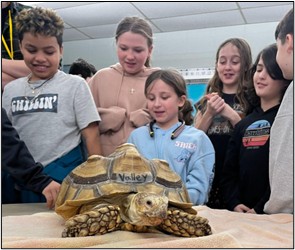
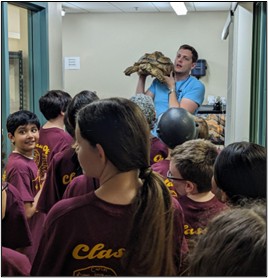
  • A Sulcata Tortoise
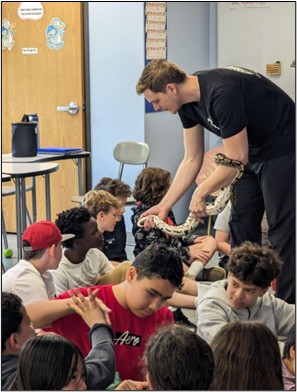
  • A Ball Python
  • Bearded Dragons
  • Box Turtles and more!

Please note that not every listed animal will be present at every event, Falco the hawk always visits.

For small groups (under 20 participants), some animals may be available for a hands-on experience. However, for larger audiences, the presentation will remain visual and educational to ensure the safety and well-being of both animals and participants.

Program Details

  • Duration: 1 hour
  • Cost: $250 for one, $400 for two, $600 for three.
  • Discount available for Title 1 schools
  • To schedule: Email our STEM director, Jack Banagis, at banagis@newildlife.org

Bring the wonder of wildlife to your students with this unique learning opportunity. We are also available to discuss any curricula focused additions, or other ways we may best integrate with students’ learning, discovery and exploration!
Field Trips at New England Wildlife Centers

Bring your students on an unforgettable wildlife adventure at New England Wildlife Centers (NEWC)! Our field trips provide an immersive, hands-on learning experience where students can explore local habitats, meet incredible animals, and discover how we care for wildlife in need.

What to Expect

Unlike our guided tours, our field trips accommodate up to 100 students at a time and offer an expanded experience, including both indoor and outdoor activities:

Outdoor Exploration

  • Guided Habitat Walks – Learn how animals survive in forests, wetlands, and meadows.
  • Outdoor Wildlife Enclosures – Observe rehabilitating wildlife and learn about their care.
  • Beehives & Pollinators – Discover the essential role of bees in our ecosystems.
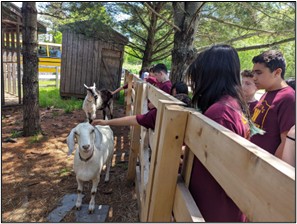
  • Goat Pen – Interact with our resident goats and learn about their role in habitat management.
  • Nature Trails – Walk through diverse landscapes and discuss how different species interact with their environment.

Indoor Wildlife Learning

  • Behind-the-Scenes Look at Wildlife Rehabilitation – Learn how we care for sick, injured, and orphaned animals.
  • Common Wildlife Challenges & Solutions – Understand the most frequent dangers animals face and how we can help.
  • Live Animal Encounters – Meet ambassador animals such as a Red-Tailed Hawk, Barred Owl, African Grey Parrot, snakes, bearded dragons, turtles, and tortoises.
  • STEM & Conservation Discussions – Explore how science and medicine play a role in protecting wildlife.

Program Details

  • Duration: ~2 hours, or more if you’d like to eat lunch on site.
  • Group Size: Up to 100 students
  • Cost: Discounted $10 per student, no charge for chaperones/teachers.
  • Location: Thomas E. Curtis Wildlife Hospital and Education Center, 500 Columbian Street, South Weymouth, MA 02190

Booking Information

To schedule a field trip, email Jack Banagis at jack.banagis@newildlife.org.

Give your students hands-on experience in wildlife conservation, ecology, and habitat protection—right in nature’s classroom!
Multi-Session Programming in Schools

The Center specializes in sustained, multi-session elementary and middle school science education, with a focus on a STEM science, technology, engineering and math curriculum. Here at the center, we know that all four of these problem solving disciplines are necessary for day-to-day life in veterinary medicine. It is our goal to teach the students that come to us about how we use these fields, how they are important in veterinary medicine, and how they can be used in almost any profession in the world. We emphasize and implement the scientific method in our programs.

These programs are traditionally Grant-funded, inquire to learn more about program costs. To become a partner school email our STEM director Jack Banagis at Jack.banagis@newildlife.org


In 2026, New England Wildlife Center Educators are offering two programs:


Health in the New World

The world around us is changing—and so is the way we explore and understand it! Through this 5-part program, students will investigate climate change and its local effects on wildlife and ecosystems. With hands-on activities, live animal experiences, real-world science, and field trips to explore nature & to visit our wildlife hospital, we’ll connect students to the environments around them and teach them how they could best make a difference.


You Can Do it Too!!

This program empowers students to see themselves as capable wildlife stewards through hands-on activities, live animal encounters, and real-world conservation problem-solving. Across three classroom visits and two field trips, students will learn that making a positive difference for wildlife can be simple, accessible, and part of everyday life.


Past Educational Programs

Kingston Public LibraryThe Wonders of Wildlife

A virtual after-school session for middle school students and their families. This program is designed to supplement their in-school science education.  In this program, students help deliver “dinner” to three patients in our hospital (a swan, an opossum, and a box turtle)  while learning about the natural history and biology of each species. By learning the types of food that each of the animals eats, helps students understand the relationship of food to the habitat in which they live. Students also learn the common reasons animals come into our hospitals and the things that they can do at home, with their families, to help keep wildlife safe. 

Eagle Brook School: Cellular Biology and Comparative Anatomy of Blood Cells

Eagle Brook School is an international boarding school located in Deerfield, Massachusetts. During COVID-19 some of the students and instructors are living at the school and some are living at home and learning virtually. Currently, the 9th grade science class is starting a unit on cellular biology. The instructors requested a program that would help make some of the concepts they were teaching in the classroom come to life for their students. Last week we delivered a program that put students in the driver’s seat as New England Wildlife Centers’ staff worked to diagnose a swan using a blood sample.  We started by introducing the requested concepts through a short PowerPoint presentation and then asked students to apply the concepts and help guide our veterinary team to a diagnosis. In the process, we were able to show students the difference between mammal and avian blood, see the different types of immune cells that exist in our own bodies, and show them what the constituent parts of blood can tell us about an animal’s health. The program received wonderful feedback and we are working to set-up an extended five-session program for later this year that will help expand on this topic. 

Community Connections: Wildlife Wednesdays

Community Connections is an organization that provides day habilitation, life skills, and employment training to people with disabilities at eight locations in Massachusetts. This winter we will be partnering with them to bring regular education programming to a sub-set of their clients who will be learning remotely. The topics will vary each month and will focus on wildlife and science education. We will focus the topics on areas that compliment their interests and help develop skills they are working on in their individual programs.

Transitions Centers: Virtual Volunteering

The Transitions Centers provide day and employment services to individuals, with Autism Spectrum Disorder, social anxiety, and other life challenges, who are working to transition to a life with greater independence. This group regularly volunteers at our Cape hospital and uses the program to hone their workplace skills. During COVID-19 they are unable to visit in person, so we will be providing a virtual program focused on animal care and the types of skills that go into caring for animals. 


New York Bar Association: Current Topics and Issues Surrounding Wildlife Care in Massachusetts

In February we will be hosting a virtual program for the New York State Bar Association’s sub-committee on Animal Welfare. This group has expressed interest in learning about the day-to-day operations of a working wildlife hospital and some of the legal and operational challenges we deal with. We will be showing them live patient care, discussing some of the drivers of admissions to our hospitals, going over common wildlife related crimes we assist law enforcement with, and discussing some of the legal initiatives we are currently working on to help improve the quality of wildlife care in Massachusetts.  

Neighborhood House Charter School:  Bats, Rats, and Cockroaches

The Neighborhood House Charter School is a K-12 charter school located in Dorchester, Massachusetts. Over the last 3 years we have developed a wonderful working relationship with their students and teachers and regularly provide science education programming. This year has been especially difficult for both the students and teachers, as they have had to switch back and forth between in-person and virtual learning. This is compounded by the fact they are located in an underserved school district and not all students have equal access to learning resources. When COVID-19 started, we were able to quickly produce some pre-recorded digital content for them so that students and their families could access it in their own time frame, helping to overcome some of the challenges. The latest program we provided is called “Bats, Rats, and Cockroaches” and was designed around a book the 5th grade was reading in English class. We used this opportunity to teach kids the science behind flight, adaptions of rodents, and why cockroaches are so good at surviving! We also talked about the connection between bats and COVID-19 and helped students better understand current events taking place in the world. We will continue to work with them, as needed, throughout this year. 

Wareham Land Trust: Wildlife of Wareham

Zak Mertz, Executive Director of our Cape facility, was recently the keynote speaker for the Wareham Land Trust and spoke about the localized issues that wildlife face in Wareham, Massachusetts. We were able to use data collected at both of our hospitals to reveal the most common reasons we see wildlife from Wareham and even which parts of town we are more likely to get patients from. Zak also spoke about a few of the common issues facing wildlife statewide such as lead poisoning, rodenticide toxicity, and car-strikes. We will continue to consult with the Wareham Land Trust on wildlife topics on their properties. 


Upper Cape Cod Regional Technical Highschool: Advisory board members and free programming for the Veterinary technology concentration 

Last school year we helped the Upper Cape Cod Regional Technical High School pilot their Veterinary Science tract. This program offers students the opportunity to major in veterinary science as a vocational tract at Upper Cape Tech. Dr. Priya Patel and Zak Mertz joined the advisory board for this program and actively work with instructors and students to provide guidance, lectures, and hands-on learning opportunities. We are entering the second year of this new program, and we expect that NEWCS will play an even larger role as the inaugural class reaches their junior and senior year. We are currently working to set-up some virtual programming for the beginning of their second semester that will help reinforce classroom concepts as skill sets. 


Wildlife Rehabilitators Association of Massachusetts (WRAM): Continuing Education for Wildlife Rehabilitators

Dr. Patel and Zak Mertz currently serve as Board Members for WRAM. As part of this commitment, they each deliver several lectures and lab sessions every year to further the education of licensed rehabilitators in Massachusetts. Each of these sessions is certified for 3 continuing education credits and counts towards the state’s CE requirements. Most recently, Dr. Patel gave a lecture on turtle stabilization, treatment, and repair. Zak gave a lecture on best practices of phone answering and communicating with members of the public regarding wildlife.

Jack BanagisEducation Programs